
The Dark Past of the Yorkshire Dales

It’s time for a little bit of terrible history…
(Definitely NOT horrible history*…)
Yes, it is time for the grizzliest and most gruesome Tales of the Yorkshire Dales. We’ll be taking a deep dive into the stories about the dastardly highwaymen, the gruesome murderers, the downright unfortunate and the unsolved mysteries of the Yorkshire Dales National Park.
Believe it or not, despite the beauty and tranquility of the Dales, it has got QUITE the dark past and plenty of mysteries to unpick. Want to find out more? Well, you’ve got this far, you may as well keep reading!
Trust me, they’re FASCINATING.
*Because that might already be taken…

Exploring Tom Taylor’s Cave at How Stean Gorge
The Highwayman, Tom Taylor
Tom Taylor was a bandit. A highwayman well known for being brutal, sadistic and without mercy. He was notorious for murder and robbery and was generally one of the baddest of all of the baddies in the Dales.
His highwayman hotspot? Upper Nidderdale, on one of the main trade routes over from Kettlewell, running across the aptly named Dead Man’s Hill, next to Scar House Reservoir (before it became Scar House Reservoir… of course).
Dastardly Tom was a menace and a thief. When his crime was complete, he would hide his loot in what is now known as Tom Taylor’s Cave at How Stean Gorge and it was in this cave, that Tom met his grizzly fate.
The story goes that in 1691 the thoroughly irritated villagers formed a vigilante group to track down the man responsible for terrorising their local highways and after being given the slip several times by the wily Tom, they finally managed to follow him into his cave. He was found and hanged right there and then, serving him with the justice he had long evaded.
You can take a little mosey along Tom Taylor’s Cave at How Stean Gorge as part of their gorge experience. The keyhole tunnel leads to a larger cavern which is said to be the place where Tom stashed his loot and met his grizzly end. Cast your eyes upwards and you may just about make out what remains of an iron bar sticking out of the cave wall. This was rumoured to be where the group hanged him.
Oh and one time, a visitor to the cave managed to capture the ghost of old Tom on camera, he is said to haunt the cave where he met his ultimate punishment.
Gruesome eh?! Thought we’d kick it off with a classic!

Mill Gill force in all it’s glory!
The Tragedy at Mill Gill Force
If you’re a fan of a waterfall, then Wensleydale is the place to be. We’re talking Hollywood famous Hardraw and Aysgarth, we’re talking stunning swim spots, and in the beautiful village of Askrigg, you’ll find Mill Gill Force. But sadly, this waterfall has a tragic tale associated with it.
Take a hike to Mill Gill Force (preferably after lots of rain) and you’ll find yourself standing at the foot of a waterfall that towers around 70 feet above you. In Summer, the trees are covered in leaves and the sheer rocky gorge that surrounds the falls are green hued, cool and permanently shady. This place always has an atmosphere, perhaps because it was the scene of a ritualistic murder back in the 1500’s.
It was here, that over 500 years ago, the bodies of two presumed lovers were found, having been killed by what was assumed to be local farmer. Chillingly, their hands had been tied with the hacked off lengths of their own hair. Why? With the murderer never convicted nobody will ever know for sure, but the ritualistic style of the killing was thought to have been carried out because of a rivalry between opposing Roma families in the area. The motive? An alleged ‘gypsy’ curse….
Seems a tad harsh a punishment for what was in fact curdled milk.
The walk to Mill Gill Force is a fabulous walk, check it out by tapping the link!

Tom Lee’s smidy… apparently
Tom Lee of Grassington
Notorious Tom Lee. SO notorious, that he has MANY versions of his tale told and there are SO MANY EMBELLISHMENTS!
Since originally writing this piece, I have read a LOT about Tom Lee. I’m going to tell you the original version of the story that I stumbled across back in 2022…
Local blacksmith, Tom Lee was the perpetrator of a terrible murder back in 1766. He murdered Dr Richard Petty in Grass Woods after returning from a cock fight over in Kettlewell. He reputedly fled the scene of the murder and hid in a nearby cave (now called Tom Lee’s cave, located in Cove Scar.
He was caught, tried and convicted of the crime and his body was then hung from chains in Grass Woods for 4 years afterwards.
And with such a grim tale associated with him of course his ghost is said to haunt the cave where he once hid.
Pretty cool tale right?
WRONG! Only part of that bears any resemblance to what actually happened that night in 1766. In reality, Tom Lee was NOT a blacksmith (despite there being a plaque on the Main Street in Grassington to tell us where his alleged smidy was). Tom Lee was a landlord and a lead miner and as a side hustle, a bit of a highwayman.
He was by all accounts, not nice AT ALL.
Dr Richard Petty was the local Doctor. He had treated Tom Lee for a bullet wound that he had sustained in an attempted robbery of a bank messenger. Tom had committed many a crime up until that point, but it was this injury that put Tom firmly in the suspicious lime light and Dr Petty was now definitely in the know about his criminal hobby. It was this knowledge that probably heavily contributed to his demise.
It is true that they both attended a cock fight that night in Kettlewell and that Dr Petty won a lot of money. It is true that Tom Lee murdered Dr Petty in Grass Woods on the way back after being seen in some drinking holes together along their return route. But the truth was far from him fleeing the scene and hiding from an angry mob in a cave. He hid the body, then later moved it to the river in Grassington and he went on living his horrible life until it eventually resurfaced in Burnsall.
It took two attempts to convict Tom of the crime, but convicted he was. He was hung from a gibbet in Grass Woods for many years given the severity of his crime (or perhaps at the bridge on the way into Grassington - the location isn’t 100% known) but there are tales that the wood is haunted by a disembodied scream to this day.
And you know what? We have a walk that heads through Grass Woods . But you won’t find me there after dark…
If you are wanting to untangle legend and fantasy from hard facts and real history, check out Mark Bridgeman’s Book on the Grassington Murder. A thoroughly interesting read and it’s thanks to him that I learned the REAL story of Tom Lee.

Thornton Force, part of the Ingleton Waterfalls Trail
The Gatenby Sisters of Ingleton
Let’s turn away from grisly murders, to misplaced poison plots (truth or myth it’s a good one, so well worth a mention)
Ingleton is a beaut of a place to visit and we thoroughly recommend that you do. You may know it as the home of the famous Ingleton Waterfalls Trail, White Scar Cave (the longest show cave in the country) and of course the second highest of the Yorkshire Dales peaks, Ingleborough. But it was also the home of the Gatenby sisters. Back in the 1600s these rival siblings both had their greedy eyes on their inheritance. However, rather than divide it all between them, they wanted it alllll to themselves.
The plan? To poison the other sibling, therefore leaving the surviving sister as the sole benefactor of the estate.
The problem? They both independently came up with the same idea, unbeknown to each other and at their mother’s funeral, they both executed their plan.
The result? They BOTH died within minutes of each other.
Doh!
The story goes that after their ill executed plan failed, the two sisters were doomed to haunt the streets of Ingleton in some kind of weird game of hide and seek. The haunting lasted for 7 years and 7 days, which was exactly the length of time it took to settle the legal battle surrounding the estate the two had their eyes set on in the first place.
*sigh.
Historically accurate? Probably not. Excellent story? Absolutely.
Find out more about the Ingleton Waterfalls Trail or Ingleborough.

The lead mine level where Buckden Bill was found
Buckden Bill
NOW we’re talking about facts.
Heard of Buckden Pike? It’s in the top ten highest peaks in the Yorkshire Dales and the views from the top stretch far and wide. The top might be crowned with a trig point and an excellent summit seat, but underneath your feet lie a network of old lead mining levels.
If you take the route up from Buckden, you’ll end up passing one of the openings to the old gavel mines, I dare you to peek inside, apparently the mine is haunted by the ghost of an old man… (don’t actually GO inside though the mine is now very unstable and liable to collapse). Back in the 60’s, a team of University Students were exploring the network of tunnels that form the Buckden Lead Mines, when they happened upon the skeleton of a man.
The skeleton was complete with felt hat and walking stick, some spare change and a card from a funeral over in Settle.
The skeleton was a mystery, but after investigation there have been some strong conclusions drawn that old Bill was once a lead miner in the area, before the industry collapsed in 1870 and that some 20 or so years later, this chap ventured back, perhaps for old times sake whilst he was in the area.
When the tunnels were investigated by the rescue team after the discovery of Bill, it was said that the boot marks of the old lead miners were still visible in the mud and the candles were still placed in the walls… spooky huh?
Want to check it out? Head to our Buckden Pike walk!
The Buckden Pike Air Crash
We are heading back to 1942 for this little piece of tragic history and to the Polish crew of Wellington N2848 who were on a training flight from Warwickshire. It was January and there were blizzards and high winds, which probably resulted in them deviating off their intended course, which was for Carlisle.
Sadly, the plane crashed into the wall near the summit of Buckden Pike killing all but two of the crew. One was very badly injured and unable to move off the mountain, so his crew mate set him up a shelter and he went for help. The story tells us that he followed fox pawprints in the snow, in the knowledge that foxes would almost always aim for houses and people and he ended up at the White Lion in Cray (sadly, now closed).
There, he was looked after but because of the strength of the blizzard, a search party wasn’t able to go up the mountain to find his crewmate. A couple of days later when conditions eased, they ventured up to find that the remaining survivor had sadly succumbed to exposure, but Joseph Fusniak, survived.
There now stands at the site of the crash a memorial to those who lost their lives and concreted into the foundation of the memorial is what’s left of the wreckage of the plane.

The epically proportioned Ribblehead Viaduct
The Navvies at Ribblehead Viaduct
Grizzly ghouls as a result of hardcore history?
The Ribblehead Viaduct is absolutely MASSIVE and is a huge achievement in terms of structural engineering. It was opened to freight in 1875 after several years of hardcore construction and then later to passengers. The navvies responsible for the building of the viaduct numbered in their thousands and were stationed in camps across Blea Moor.
If you’ve ever been to Blea Moor, you will know that it is bleak, desolate and at the mercy of the elements. Located near the lower slopes of Ingleborough and Whernside, the Moor would have been a pretty grim place to live (cracking views though...).
Therefore, you won’t be surprised to hear that the Navvies had an equally as grim life up there. The camps were rife with smallpox, and disease and if that didn’t get you, you might meet your doom in one of the regular brawls or die from the extreme cold. Camp-life was tough for the Navvies and for those families who joined them. If it wasn’t the conditions that got you, it could have been the far from safe practices in constructing the viaduct.
Navvies were not well liked by the locals and crime increased when they were living there. One such crime is recounted in The Dark Side of the Dales by Mark Bridgeman, having taken place in Langcliffe near Settle. Two navvies were responsible for the assault and murder of a local beer-seller, Christopher Wright.
The place where the Navvies camped is now designated as a historic site of interest and if you go, you will be able to find out more. Check out our Ribblehead Circular Walk whilst you’re there.

Hardraw Force after heavy rainfall
Hardraw Force
The tallest single drop waterfall in the country no less (above the ground, below it’s Gaping Gill). This super famous waterfall is found behind the Green Dragon Pub in Hardraw, just outside of Hawes in Wensleydale. It’s not just famous for it’s height though, it was used as the location for THAT ‘shower’ scene in Robin Hood Prince of Thieves, but apparently Kevin Costner didn’t actually even enter the waterfall (his body double did!)
Anyway, whilst Hardraw is pretty famous, it’s also associated with a gruesome tale!
The story goes that one stormy night (the perfect setting for every grizzly story) a brawl took place at the top of the cliff from which Hardraw Force drops, the victim was killed and thrown over the edge by his attackers, falling to his doom.
It was believed that this tragic ending was as a result of a suicide, which resulted in the poor chap not receiving a burial in consecrated ground Perhaps that was the reason that on stormy nights angry shouts can be heard above the roar of the 100 foot cascade.
It wasn’t until further investigation was carried out that the truth was discovered and remains of a melted dagger was found at the point where the victim was thrown. Weird huh?
Find out the details of how to get to Hardraw Force by tapping on the link or try our Hardraw and Shaw Gill walk!

All the ruined buildings in Lodge are given a plaque to say what they once were
Dead Man’s Hill, Nidderdale
If you head into Upper Nidderdale, only a stone’s throw from How Stean Gorge and Tom Taylor’s cave is Scar House Reservoir. The construction of the reservoir is far from the boring and ugly concrete affairs you regularly get with reservoirs, it’s really quite something and when it’s full and overflowing, it creates a waterfall of spectacular proportions.
Construction was completed early in the 20th Century and in building the reservoir, the settlements of West Houses, Angram and Haden Carr were submerged. In drought, you can see the ruins re-emerging from the water, complete with the old trade road. It’s fascinating to go and see. Lodge was not flooded, but abandonment was ordered to prevent the drinking water from becoming polluted by farm run-off.
The trade route ran between Middlesmoor, along what is now underneath Scar House reservoir to Lodge and then eventually onto Coverdale and Wensleydale. It heads over ‘Dead Man’s Hill’. But why is it called that?
Lodge was a village which dated back to the 12th Century. With it being directly on the trade route, you can imagine the number of people passing through and of course, there was an Inn to house those making longer journeys. The Inn was chosen by three Scottish pedlars who were travelling with their wares as their accommodation, but sadly they did not continue their journey. Back in 1728, their bodies were found buried in the peat of the hill with their money, possessions and heads gone.
The hillside is said to be haunted by the spirits of the three Scottish pedlars and it was after that point that the hill once known as Nidderhaw became Dead Man’s Hill.
Walk to it on our Scar House Reservoir walk!

Robin Proctor’s Scar is featured ahead
Robin Proctor’s Scar
Oh dear, Robin Proctor.
If you take a little trip to the Norber Erratics near Austwick and Clapham, it’s likely you’ll encounter Robin Proctor’s Scar. But why was the OG name of Norber Scar ditched in favour of old Robin?
Well, Mr Proctor was a famer from Crummackdale Farm. He was very partial to a tipple (or seven) at the local pub, an establishment that he regularly frequented on his trusty old horse. He would ride to the pub, partake in several ales and then mount his horse for the return journey, more ofter than not falling asleep on his way back. Fortunately, his horse had done the journey to and from the pub so many times, he didn’t need to be told what to do and would safely bring Robin back home to sleep off the beer!
Clever Horse!
Except one night, one particularly stormy night (of course) old Robin couldn’t resist the draw of the pub. Much to the dismay of his wife he set off anyway, braved the weather and fortunately (or not I suppose) made it there safely. He stabled his horse with all the others. As the weather was so bad, everybody had opted for horseback as their preferred mode of transport and so there were quite a few horses under the shelter (can you see where this is going?!) The evening took its usual course and he ended up blind drunk. So drunk, he mounted the wrong horse, a horse who had NO idea where he was going.
Old Robin passed out drunk as usual and his horse being unfamiliar with the route home, blindly wandered onto the top of Norber Scar.
Then? Well with the terrible weather, terrible visibility and terrible life choices made that day, the pair plummeted over the edge on to the rocks below. The ghost story goes, that the sound of the horse's hooves can still be heard on stormy nights.
Want to walk it (no… NOT off the top!) Head to our Norber Erratics walk.
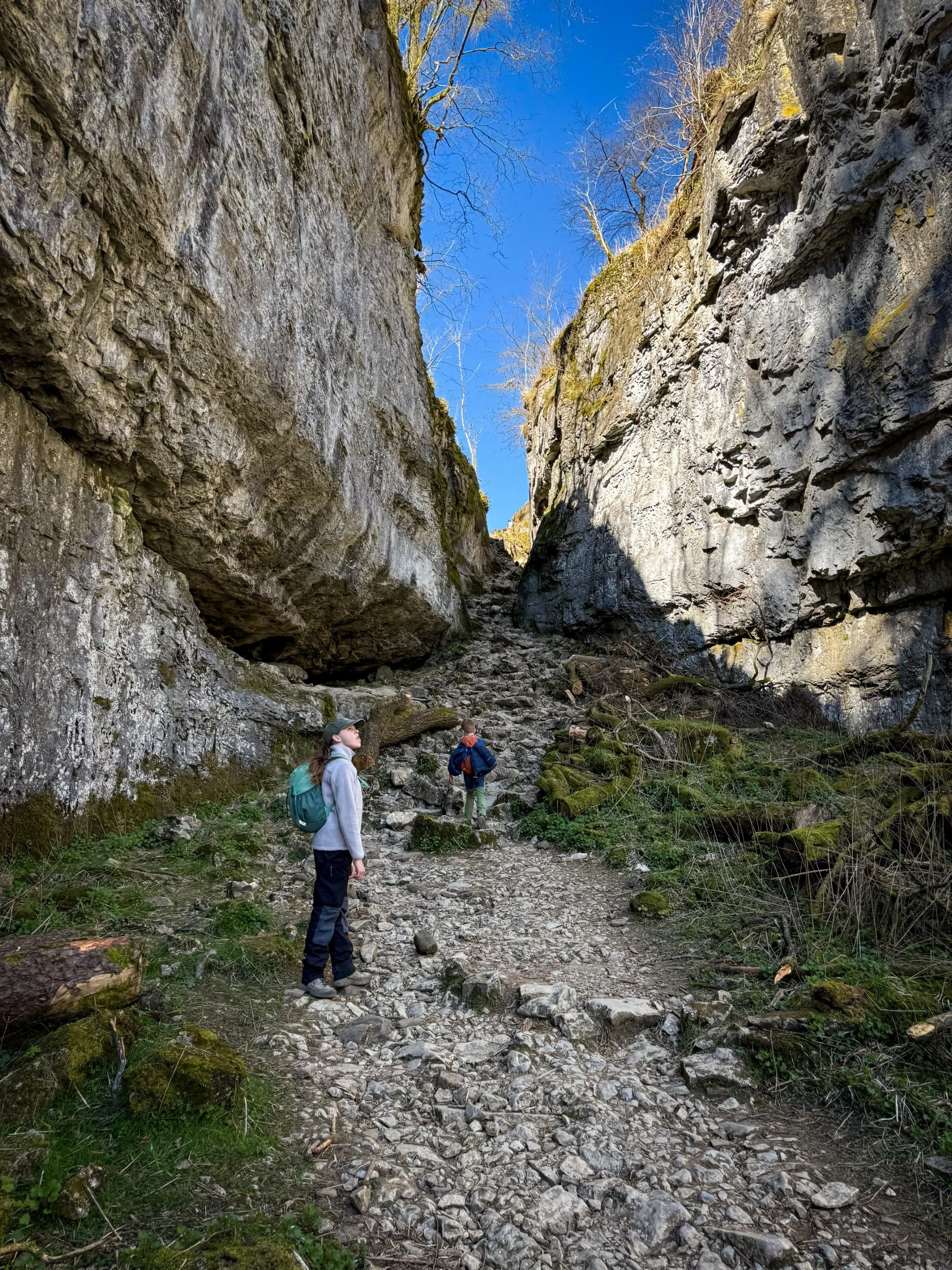
Trow Gill on the way up to Gaping Gill and Ingleborough
The Spy of Trow Gill
Next up, a real life unsolved mystery, just a stone’s throw away from Robin Proctor’s Scar.
If you’ve ever decided to take a hike up Ingleborough from Clapham, you will have undoubtedly at some point have walked through the spectacular Trow Gill… unless you have gone catastrophically off piste. The gorge was created by glacial meltwater after the last ice age, which created the two vertical rock faces, now used frequently by climbers.
As you head up the gill from the direction of Clapham, above and to the right of Trow Gill, lie Clapham Bottoms. This stretch on the lower slopes of Ingleborough is dotted with shake holes and pot holes and one such unassuming cave is the scene of our mystery.
Back in 1947, a couple of caving buddies, Jim Leach and Harold Burgess (known as Budge) were on the hunt for alternative entrances into the Gaping Gill cave system, which lies just beyond Trow Gill. They entered what is a small entrance to a cave and almost immediately spotted a pair of shoes sticking out from underneath a rock. It very quickly became clear that those shoes were attached to a skeleton and the cavers swiftly made a retreat to go and report what they had found and seek help.
The body was removed from the cave, but what was odd was that it appeared to have been ‘walled in’. When the body was examined, it was estimated that the unfortunate soul had died any time between 2 and 6 years previously, during the time of the second world war. The post mortem and forensic examination showed that he was about 5 foot 5 inches tall, that he was wearing a grey overcoat and trilby hat and that he had a plum coloured scarf around his mouth, essentially gagging him.
Amongst his possessions were a glass jar of cyanide, almost but not quite full along with a broken ampule and coins dating back to no later than 1939. It was concluded that he had most likely died in 1941.
The ampule found was the kind used by spies during the second World War and despite him remaining a mystery, links have been drawn to the German Secret Service.
Another tragic mystery in the Yorkshire Dales! I hope you’re suitably intrigued! If you want to walk through Trow Gill check out our Gaping Gill walk or our Ingleborough Walk.

If you love a Yorkshire Legend…
Check out the rest of our series of Tales of the Yorkshire Dales!
Sources:
There are so many different sources for all of our beastly tales!
The Dark Side of the Dales by Mark Bridgeman
The Grassington Murder by Mark Bridgeman
Lodge, North Yorkshire - Wikipedia
A Three Peaks Up and Under : A Trow Gill Skeleton: The Unsolved Mystery of Body Pot
Telegraph and Argus,
Craven Herald,
Haunted Yorkshire Dales by Summer Strevens