
Folklore of the Yorkshire Dales

Welcome to our beastly folklore of the Yorkshire Dales!
Folklore, legends, myths and tall tales, the Yorkshire Dales is jam-packed FULL of them! Yes, we have so many legendary stories to tell that it’s taken years to put them all together!
But together they are and if you love a fairy, giant, boggart or mythical kelpie, well you need to head to the Yorkshire Dales because you will quite literally tripping over them… or the rocks they threw. Apparently there’s a lot of that that goes on in these here days of yore (which is basically the era of time that I’m attributing to all of these legends!)
So read on, these beasties are waiting for you!

Want to know a bit about the history behind folklore?
First things first, cast your mind right back into the days of yore (told you). Folklore has been around for donkey’s years (another accurate historical time period). It has existed as long as the human race has had the ability to communicate and way before they had the means to record it. There is no defined historic period that can be associated with it, because these stories are a wonderfully organic thing.
Even now, we have folklore being created (ever heard of an Urban Legend?)
The belief in fairies and hobgoblins, in ghosts and demon dogs, in legendary creatures (with far from fairytale designs) all stem from the human desire to share stories, warn of danger, or explain something that escapes understanding. And they exist today, as much as they did hundreds and thousands of years ago.
Folkloric stories could be derived from the desire to increase the attraction of a place to tourists, perhaps to make it feel a bit more ‘edgy’ and to boost some businesses in the meantime. Some of them are a cautionary tale to frighten folk away from a treacherous place. Some are associated with superstition or provide a way of explaining away natural phenomenon, that otherwise was misunderstood. Some, just a reyt good story to tell down the pub!
But what is fascinating (other than them giving an insight into the minds of the folk of the past) is that they have the infinite ability to reinvent themselves, to be embellished with extra sparkly details, and that is the beauty of the folklore of the UK. And of course, the Yorkshire Dales.
Take a look, what do you think? What can you add to the Folklore of the Dales?
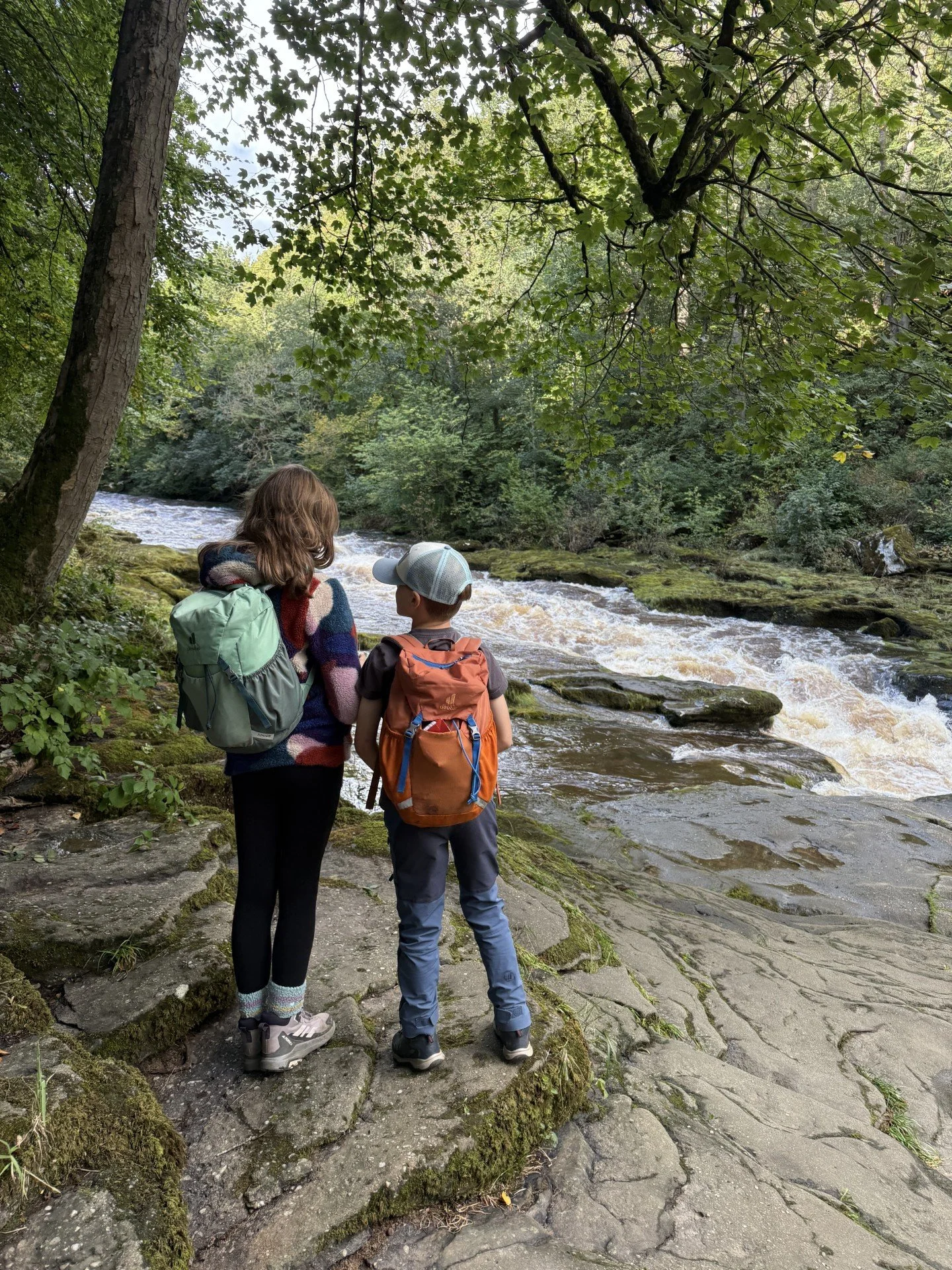
The treacherous Strid at Bolton Abbey (stand well back!)
The Kelpies
The Strid Kelpie: Bolton Abbey, Wharfedale
Ah the infamous Bolton Abbey and its even more infamous ‘Strid’…. Ever heard of it? Well, let me fill you in!
This treacherous stretch of the River Wharfe cuts right the way through the middle of the Strid Woodland on the Bolton Abbey estate. Stand on the viewing platform and you’ll be able to see the entire contents of the river being forced through a narrow rocky channel, which creates a cauldron of angry water. Before this point, the river spans roughly 30-40m in width, but at the Strid it decreases to a width so narrow, it is tempting to ‘stride’ across. But if you tried? It would NOT end well.
Not only are the rocks slippery and dangerous, the sheer force of that amount of water being funnelled into a tiny rocky ravine has resulted in a massively deep chasm. A chasm so deep, that there is a lot of speculation as to how deep it actually is, but I can in fact exclusively confirm that the answer is…
It’s really REALLY deep.
Underneath the surface of the violently boiling water are eroded holes, submerged caverns and deep ledges to be trapped under, and if I’ve managed to describe it well, then you won’t be surprised to find that it has claimed lives in the past.
Most notoriously, in the 1100’s the boy of Egremont, a William de Romilly (son of Alice de Romilly, who resided in Skipton Castle) reportedly attempted the stride and never made it. But sadly, also in more recent years too. This really is not a place to be messed with and so in terms of folklore, it’s not surprising that tales have been told to try to explain the danger or to warn folk away from this deadly place.
The legend goes that in the water there lies a beautiful glowing shape-shifting kelpie (a water horse - think Frozen 2 - if you know, you know) and a vengeful fairy. These two dastardly characters are the baddies of the story, the reason why the fearsome Strid… is quite so fearsome!
The Kelpie likes to lure people onto its saddle. Once mounted, you cannot get off and the terrible duo will then take you down, deep into the water and drag you under the ferocious torrent to your demise….
And with a cautionary tale like that (probably exactly why the story was created in the first place)…. Keep out of that there Strid! But why not check out some of the Bolton Abbey trails , they’re far less deadly (although you may encounter a few ghosts along the way instead!)
The Ure Kelpie
From Wharfedale to Wensleydale and ANOTHER Kelpie, this time one that jumps out of the water near the point where the River Cover meets the River Ure.
This one doesn’t drown you, but it will eat you. So… I’d steer clear if I were you unless you want to become this water demon’s afternoon snack!
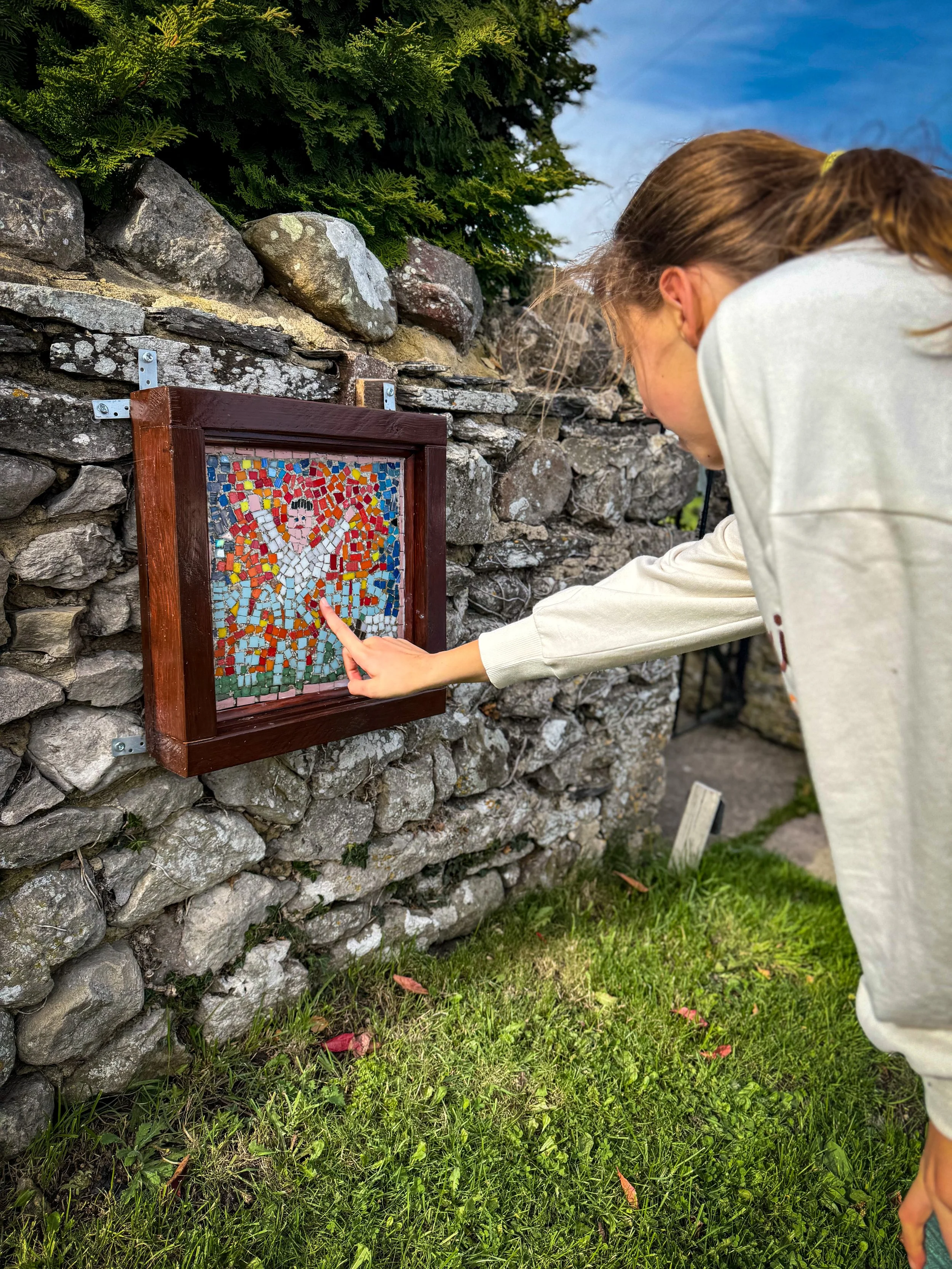
Bartle, the possible giant of Penhill above West Witton in the Yorkshire Dales National Park.
The Giants
The Giant of Penhill
This is up there with one of my favourite Tales of the Dales EVER and as with only the FINEST folk tales, it has SO many blummin versions of it, which is always a true testament to how many times the tale has been told and how much it is revered.
But before we launch into his story, let’s take a second to a appreciate one of the most unique traditions in Yorkshire. The Burning of Bartle. This is a tradition that happens in West Witton in Wensleydale every year in August. This beautiful village is found on the edge of the National Park near Leyburn and is tucked away under the prominent Penhill, it is the unassuming setting for what is one of the Yorkshire Dales’ oldest traditions, dating back at least 400 years and possibly pre-dating ACTUAL bonfire night and the Gunpowder Plot in 1605.
Penhill boasts Robin Hood’s Well, an historic beacon, a thriving adder population and…. the Giant of Penhill. The Giant was not a particularly friendly sort and became renowned for being downright mean. The Giant lived in a castle on Penhill, with panoramic views stretching across Wensleydale. His prized possessions were his pigs. He loooooved his pigs. Some say his pride and joy were stolen from the village of West Witton, some say he murdered a shepherdess from the village after killing her flock of sheep because they weren’t as wonderful as his beautiful pigs and SOME say, he was murdered by the ghost of his wolf hound. BUT.
Some say, he is the inspiration for the Bartle burned every year in West Witton. What’s the story behind that?
Well…. as the doggerel goes…
‘On Penhill Crags, he tore his rags
At Hunter’s Thorn he blew his horn
At Capplebank Stee he brak’ his knee
At Grassgill beck he brak’ his neck
At Wadhams End he couldn’t fend
At Grassgill End we’ll mak’ his end
Shout, lads, shout!’
So…. as it turned out things didn’t end well for the giant of Penhill.
The truth is, the origin of the tradition is unknown and in all likelihood the doggerel doesn’t refer to a pig-loving giant with a penchant for real estate, but it speaks about the unfortunate demise of a prolific livestock thief. But either way, I know which version I prefer!
If you fancy trying the trail, then check out the Bartle Walk and why not check out the two pubs in the village (both known for being haunted - bonus!) Parking for the trail is near the play park in the parking layby before you enter the village.
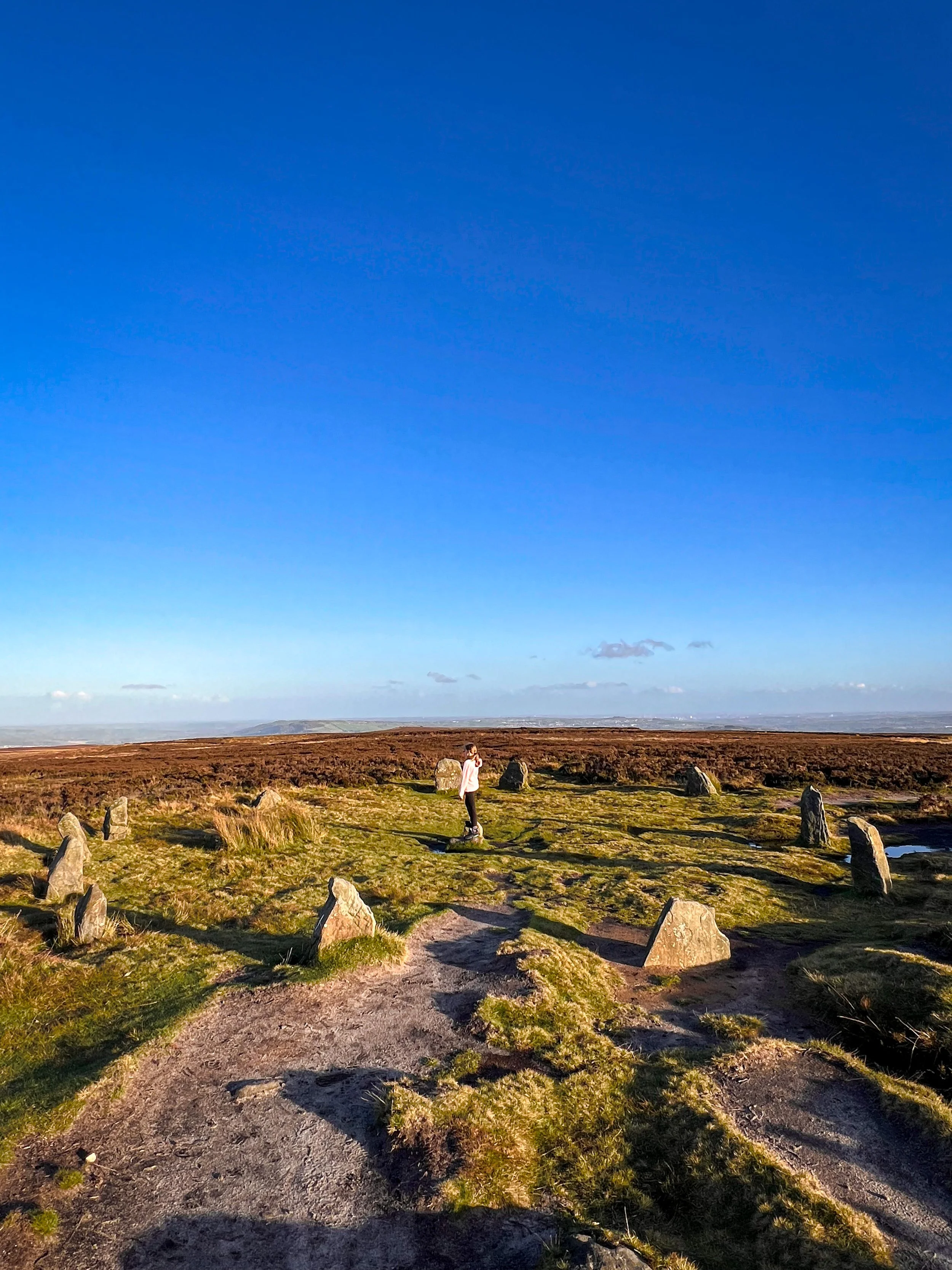
The Twelve Apostles, an ancient stone circle on Rombalds Moor
Rombalds the Giant: Ilkley Moor, Wharfedale
Ah I LOVE this story!
So. ‘Rombalds’ is the name given to the whole of a moorland range, including Ilkley Moor (b’aht ‘at and that) Burley Moor, Bingley Moor and Morton Moor. It stretches from Silsden all the way to Hawksworth and it was the home of Old Rombalds the Giant, and his wife. These guys, have a great tale to tell.
One day, they had a proper massive barney… (maybe she was sick of him CONSTANTLY LEAVING HIS SHOES NEXT TO THE SHOE CUPBOARD or something else. It MIGHT have been something else).
This argument resulted in old Rombalds trying to leg it across the moor to escape the wrath of his angry wife. But Mrs Rombalds was NOT letting him get away that easily. Oh no! She chased after him chucking massive rocks in his direction (and as I like to imagine, screaming shoe-related obscenities.) In trying to escape the rock hurling, Rombalds attempted to leap across the valley to the other side and used the rocks of Ilkley Moor to launch himself. In doing so, he cracked the rocks and created the famous Cow and Calf on Ilkley Moor.
His wife, presumably not bothered enough to follow her fleeing husband (or perhaps simply content to let him go and never come back), dropped the rocks that she was carrying in her skirt and thus produced the ‘Skirtful of Stones’ on Burley Moor.
Was this story as far-fetched as the well known ‘alien of Ilkley Moor’ who was spotted by an ex-police officer back in the ‘80s?
I’ll let you decide… perhaps an Ilkley Moor walk will help with that decision making process!
The Giant with No Name: Addleborough
If you head to Raydale and to Semerwater, you will see the curiously shaped flat topped Addleborough which overlooks it. It is here that another giant once lived. A giant with no name.
Now, I’m not sure what you think, but if I were in the Dales back in the days of yore, there’d be blummin’ giants all over the place! Literally, falling over them (not under them, that’d probably not end well) and if I were this particular giant, I’d be pretty miffed.
WHY ON EARTH HAS HE NOT GOT A NAME?!
So in an executive decision, I will be naming him Alan. Alan of Addleborough. There aren’t enough Alans in the world.
So ‘Alan’ had a bit of a to-do with the Devil (another one who’s a regular visitor apparently). However, in a move away from architecture (see below) the Devil decided to go and stand at the bottom of Addleborough and generally be a bit of a pest to our friendly neighbourhood giant, ‘Alan’. Yes, in a change from the norm he was actually a friendly giant, not one that ate babies or something. Definitely a BFG type.
Alan started chucking rocks at the Devil. The Devil started to chuck rocks at Alan.
And that’s basically how the story goes. No name, no real beginning, middle or end. Just a load of stone throwing. The Devil’s stone on Addleborough and the mermaid stones in Semerwater are ones that the Devil and Alan have chucked. The Devil stone has his fingerprints on it apparently.
Not content to simply be remembered for having a rock fight, the giant (still with no name) is also known for having dropped his treasure on the top of Addleborough. His carelessness was punished by never being able to pick it back up again, but a human could IF (and only if…) a phantom chicken OR ape appeared to him (no, I’m confused too). Now if this person was so lucky to see the chicken (or the ape) he would have to reach and grab the treasure immediately and with no sound. If he made a sound, he lost the chance to get the treasure.
Seems likely that that treasure’s still there then right?!

Yordas Cave, the Yorkshire Dales. Folklore also says it was the home of a Giant.
Yorda The Giant: Yorda’s Cave, Kingsdale near Ingleton
I am taking the giant theme and running with it…. (sorry, Rombalds related pun!)
Yordas (or Yorda’s) Cave is located in the little known dale of Kingsdale in the Yorkshire Dales National Park. Just up from Ingleton (famous for its waterfall trail and White Scar Cave), it is the lesser known ex-Victorian show cave, which coincidentally used to be the home of old Yorda the Giant, who gave the cave its name.
This Nordic Giant was said to have used the cave as a home, probably owing to the fact that it is blummin’ gigantic inside and there is a version of the story that says he had a penchant for eating children, such is the way with these here giants ( see good old Sir Tarquin down below). Why on earth a Nordic giant decided to set up shop in a Yorkshire cave, I don’t know. Possibly, he was on holiday. OR…
The other explanation for the name is that it is derived from the Norse ‘jord ass’ which means ‘earth stream’.
Now, the fact that there is a ruddy giant waterfall inside the Chapter House of Yordas Cave and that there is a stream running right the way through the middle of it, COULD explain the ‘earth stream’ thang.
And the construct of a Nordic Giant living there might well have given the boost that this once profitable Victorian Show cave needed, to appeal to even more tourists. Well, I wouldn’t like to speculate.
Blummin’ great cave though! Check out how to get to Yordas Cave by tapping the link!!
The cave floods after heavy rain, so do not attempt to access under those conditions. Take wellies and a couple of strong torches if you choose to enter in more clement weather, as the water runs right the way through the middle and you will get wet feet!

Trollers Gill in the Yorkshire Dales. Folklore says it is the home to trolls and a demon dog!
The Spectral Hounds
The Barghest of Trollers Gill: Skyreholme, in Wharfedale
It is time. Enter, THE DEMON DOGS!
Trollers Gill is known for a whole host of folkloric characters, but the most well known are the trolls and the demon dog, or ‘Barghest’, as this spooky mutt is more formally known.
Legend tells us that the deep limestone ravine is plagued by rock throwing trolls, who climb to the heady heights of the gorge and aim for the heads of those walking through it. Speculation tells us that this is how the gill got its name, although that may not be entirely true.
This is the joy of folklore. The more popular a tale, the more versions of it you’ll find!
What is for certain though, is that Trollers Gill is an intriguing place. In usual circumstances you will find a mainly dry river bed, with water that simply disappears at the gill head, before reappearing again at the bottom. Whilst this very phenomenon seems remarkable, what you are seeing is an ephemeral river, one which only occasionally flows due to the geology of the area. When at Trollers Gill, what lies beneath your feet is a network of caves and tunnels that the water runs through underground before reappearing at the bottom. It’s only after prolonged heavy rain that the underground world floods and the water spills out into the gorge.
No wonder that this curious place is the home of so many ghoulish creatures! Tales of fairies, mischievous imps and goblins accompany our terrifying trolls, but one story endures. The tale of the Trollers Gill demon dog.
This particular story has stuck around for centuries, having been immortalised in song. ‘The Legend of the Troller’s Gill’, first appeared in Hone’s ‘Table Book’, published in 1828. The person responsible for including it, wrote it down having heard it in person from a local source (Source: Ian Humberstone - check out his thoroughly interesting article on the legend on his website)
This version talks of a ‘Troller’, or wizard (known as a ‘stroller’) who heads into the gorge with the sole purpose of conjuring the beasties that lived therein. Upon surrounding himself with a protective circle, he uttered the words ‘Forbear!’ Summoning the hellish creatures to him. He met a grizzly end and was found the next day with inhuman bite marks by a shepherd at the entrance of the ravine. He had not survived his encounter with the beast of Trollers Gill… The Stroller, or ‘Troller’ is said to be the REAL reason the gill was given its name.
It’s said that the tale of the Barghest of Trollers Gill was an inspiration for the Hounds of the Baskervilles by Sir Arthur Conan Doyle. His mother lived near Ingleton in the Dales and was a keen story teller. It is almost certain that she would have heard about the legend. Whether or not that claim to fame is more folklore than fact… I’ll leave that up to you!
Want to walk the walk of the Demon Dog? OF COURSE YOU DO! Head to our Trollers Gill walk, that co-incidentally takes you past Hell Hole too. Boom.

Ivelet Bridge in Swaledale
The Barghest of Ivelet Bridge: Swaledale Yorkshire Dales
Ever heard of Ivelet Bridge in Swaledale?
It’s seriously, THE most fun bridge to drive over EVER! But not only that, this steeply humped back bridge dates back to 1687 and is a Grade II listed structure.
It is a stunning place to visit, to pull up and have a paddle or a swim.
But it has a far more macabre past, as the old 16 mile Coffin Route (the routes taken by pall bearers in the most remote parts of the country to carry the deceased to the nearest cemetery) ran right across the bridge running between Keld and Grinton. The old coffin stone can still be found on the far end of the bridge, this is a place where the carriers would place the coffin and take a break.
It is not the home of a human spirit though, but a Demon Dog, a Barghest, who when he appears on the bridge, brings a terrible fate for anyone who saw him.
So as you’ll see, the Yorkshire Dales is fraught with bloody Hellhounds! You can find a rainbow version over in Grassington (I like the sound of him), another in Dob Park near Otley…. and in Aysgarth too!
So watch out, there’re Barghests about!

Elbolton Hill is ‘full’ of fairytales
Fairies and Goblins
Elbolton Hill: Wharfedale
This weird moundy lump is located just outside of Linton near Grassington and Burnsall in the Yorkshire Dales.
It’s pretty easy to spot because it and several others nearby stand out from the crowd. To look at them, you would almost certainly describe them as being a hill, contrasting to the surrounding rugged moorland of Burnsall and Cracoe Fell.
And that’s probably why it was given an equally weird and wonderful story to explain it being different from the rest…
Fairies. Yes, Elbolton Hill is a hill full of fairies. I know what you’re thinking, it is OF COURSE the obvious and logical conclusion to something sticking out like a proverbial sore (and green) thumb. But we’re not talking about your cute Tinkerbell types. Oh no.
These fairies have a more murderous design. The Elbolton fairies exist only to lure away unwary travellers from their safe path, to meet their certain doom. Shining their ‘corpsie’ lights, passers by are unable to resist the lure of the ethereal glow and disappear, to meet their end at the hands of the vengeful fairies.
I mean I am ALL OVER the fairy theory, but the real reason it is so ‘moundy’ is not because of the fairies, it’s because of the fact that it used to lie at the bottom of a warm tropical sea. I know. I’m a total party pooper. What you see today is what remains of a reef knoll. It is simply an accumulation of prehistoric coral, algae, and subaquatic creatures that created the strange mound shape you see today, and all that ancient fertiliser is why it’s so grassy.
Its limestone composition is also why it has its own cave too! Leaky limestone! This sedimentary rock is created by the accumulation of layer upon layer of sea creature sediment, which over time traps other dead sea creatures. It gets compressed and forms rock that is EXCELLENT for fossil hunting. And it’s the reason why you’ll find so many sea creature fossils in the Dales, despite the fact that it is MILES from the nearest beach! Over time, the tiny amount of acid in the rain slips into the cracks in the soluble limestone, it dissolves the rock and after hundreds of thousands of years, cave systems are created. Cool huh?
Elboton Cave is located near to the summit cairn of the hill and was used as a prehistoric burial chamber. The bones found there are on display at the award winning Craven Museum over in Skipton which is free to enter and is excellent as part of a day out with the kids in Skipton.
The cave isn’t accessible though. Access is through a vertical shaft and unless you’re an experienced caver, your fate may turn out worse than if those pesky Elbolton fairies got you with their corpsie lighs!
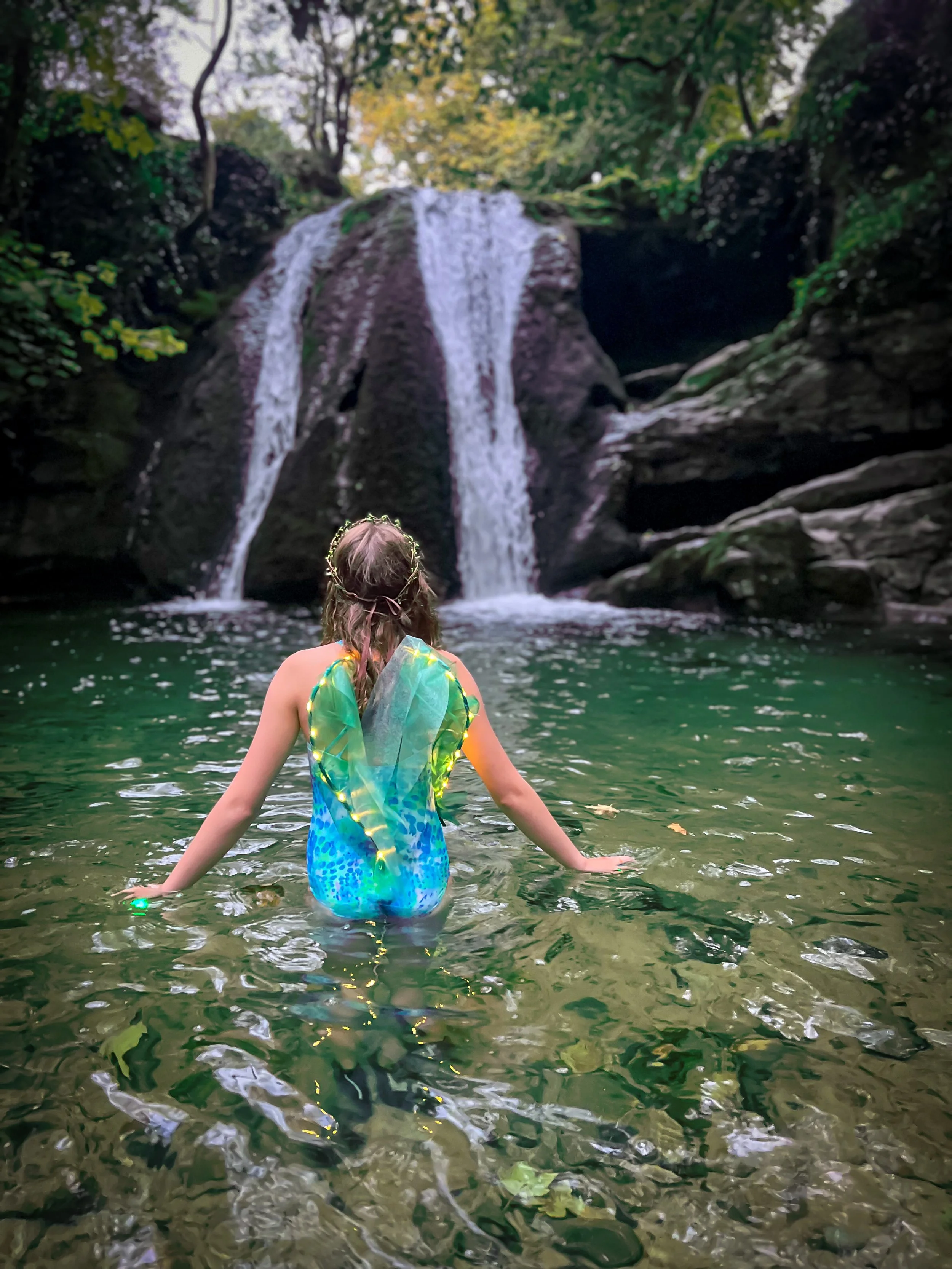
Janet’s Foss in Malham where the Queen of the Fairies lives
Janet, the Queen of the Fairies: Malham, Yorkshire Dales
Now this tale is one that is a classic Yorkshire Dales fairy tale, and is one that spans well over 250 years.
Janet’s Foss is a popular and very pretty waterfall in Malham. If you have ever visited her during the Summer months you will be TOTALLY on board with this tale, as the whole area is a vision in green. From the moss covering the tufa of the waterfall, to the canopy of trees overhead, to the unusually clear almost turquoise quality of the water in the pool below. This place is literally the stuff of dreams (as long as you go before the crowds arrive and ignore the litter they leave behind - sorry – my biggest bug bear… if you decide to go, take your litter picker to help the cause!)
But there’re always two sides to any story, and in some versions of this tale, Janet has been given a more terrifying alter ego...
But let’s start at the beginning shall we?
A beginning, which began…. well nobody really knows actually. I have read SO many versions of Janet, or Jennet or Gennet, however you want to spell her name, but her cave-home has been the stuff of legends for as long as people have written about her.
A very clever writer Kathrine Langrish, has recently put a lot of time and effort into researching the history of the legend of Janet Queen of the Fairies, and I highly recommend giving her detailed Janet Queen of the Fairies blog a read if you are interested in the nitty gritty details of the history (thank you to Stuart Gledhill, who runs the Facebook wild swimming group, The Dales Dippers for sending me this over!).
She traced the earliest record referring to Jennet’s Cave to 1786 in the writings of local schoolmaster Thomas Hurtley’s book about Malham. In this book, the legend was very much secured in history, and was longstanding in local folklore. But nobody knew where the legend actually started! (Cool right?)
Aside from her being ENTIRELY factual…. and obviously the queen of all things fairy (I like this theory the best) there are many explanations offered to justify Janet’s Legend.
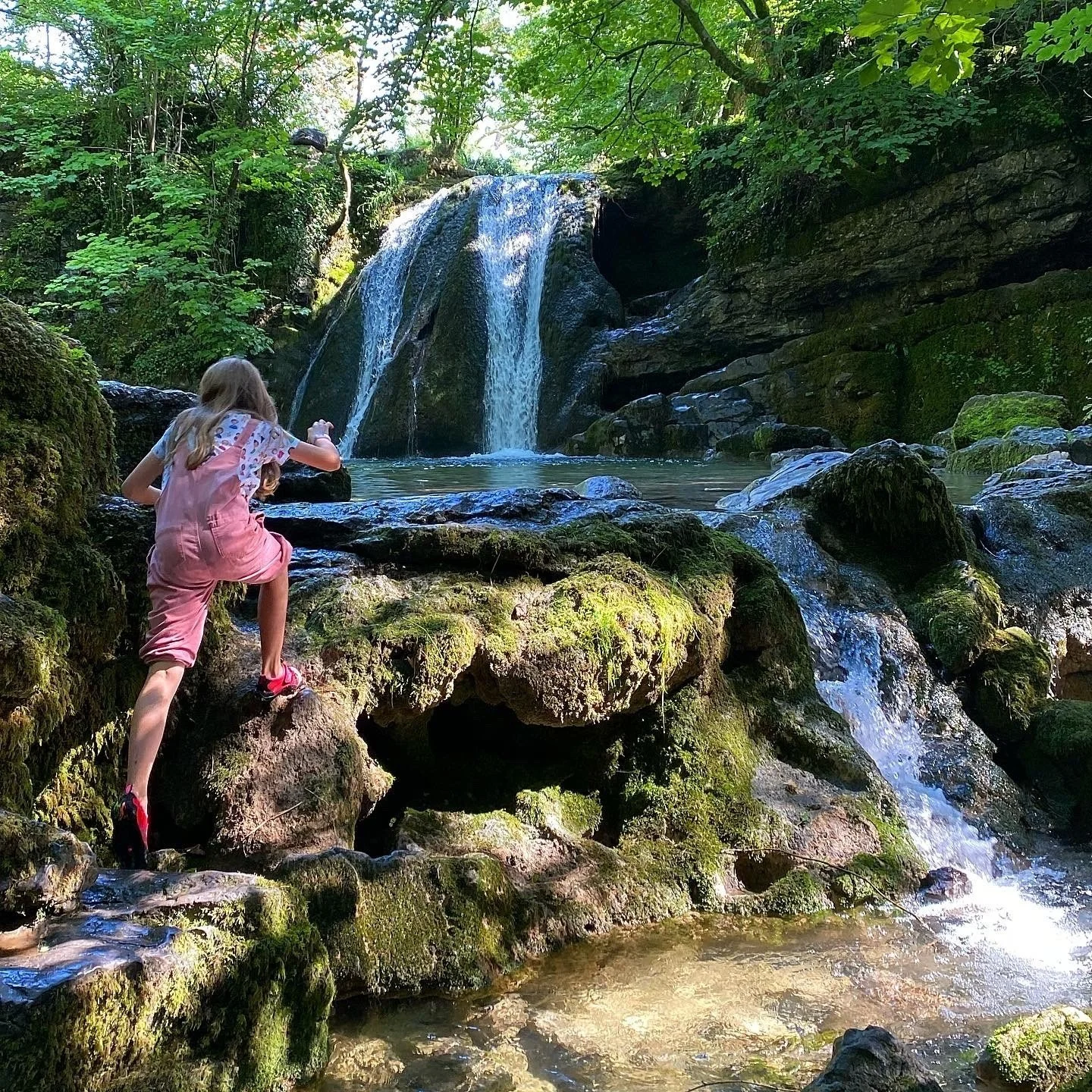
Climbing up to the main pool of Janet's Foss, to the right of the falls you can see 'Jennet's Cave' which appeared as such on a 1853 Ordnance Survey map.
Seemingly, the most likely theory, is that Janet is the Yorkshire Dales’ equivalent of the folkloric water demon, Jenny Greenteeth, who lurked at the bottom of pools ready to pray on young children who stray too close to the edge or enter the water. These tales were cautionary, to try and deter children from playing near what could be a potentially dangerous place.
Her evolution from an evil water dwelling spirit to a cave-dwelling fairy, well that could be for a whole host of speculative reasons, which we will never know the real answer to. One common reason for the ‘polishing’ of a cautionary tale to make it a little more palatable, is tourism. Malham has been touted as a true tourist destination since the 18th Century, but whether this is the real reason here, we don’t know.
But another, more modern day description of Janet, puts her firmly back into the category of terrifying water demon…
These tales will tell you that Janet is not your friendly type at ALL! She is a green wraith like figure, who will show you visions of horror should you enter the water… she has terrorised several unwitting dippers, and appears as a green mist hovering over the water, leaving her victims unable (or unwilling) to describe the visions they were shown by Janet.
These are more terrifying versions of Janet’s story, claiming the water of Janet’s Foss is in fact haunted, the most recent account of this being dated as recently as 2016 (source: Haunted Yorkshire: Nick Tyler).
Now, I’ve entered the water at Janet’s Foss on many MANY occasions (even at night. Even ON MY OWN! I mean that in itself should shock you the most given the popularity of the waterfall). But no green mist for me. I’m firmly in camp Tinkerbell when it comes to the Queen, but if you want to test the waters for yourself, head to our Janet’s Foss walk and have a quick read of our safety information and tips.
Oh and LEAVE NO TRACE. Or that evil Jennet will get you.
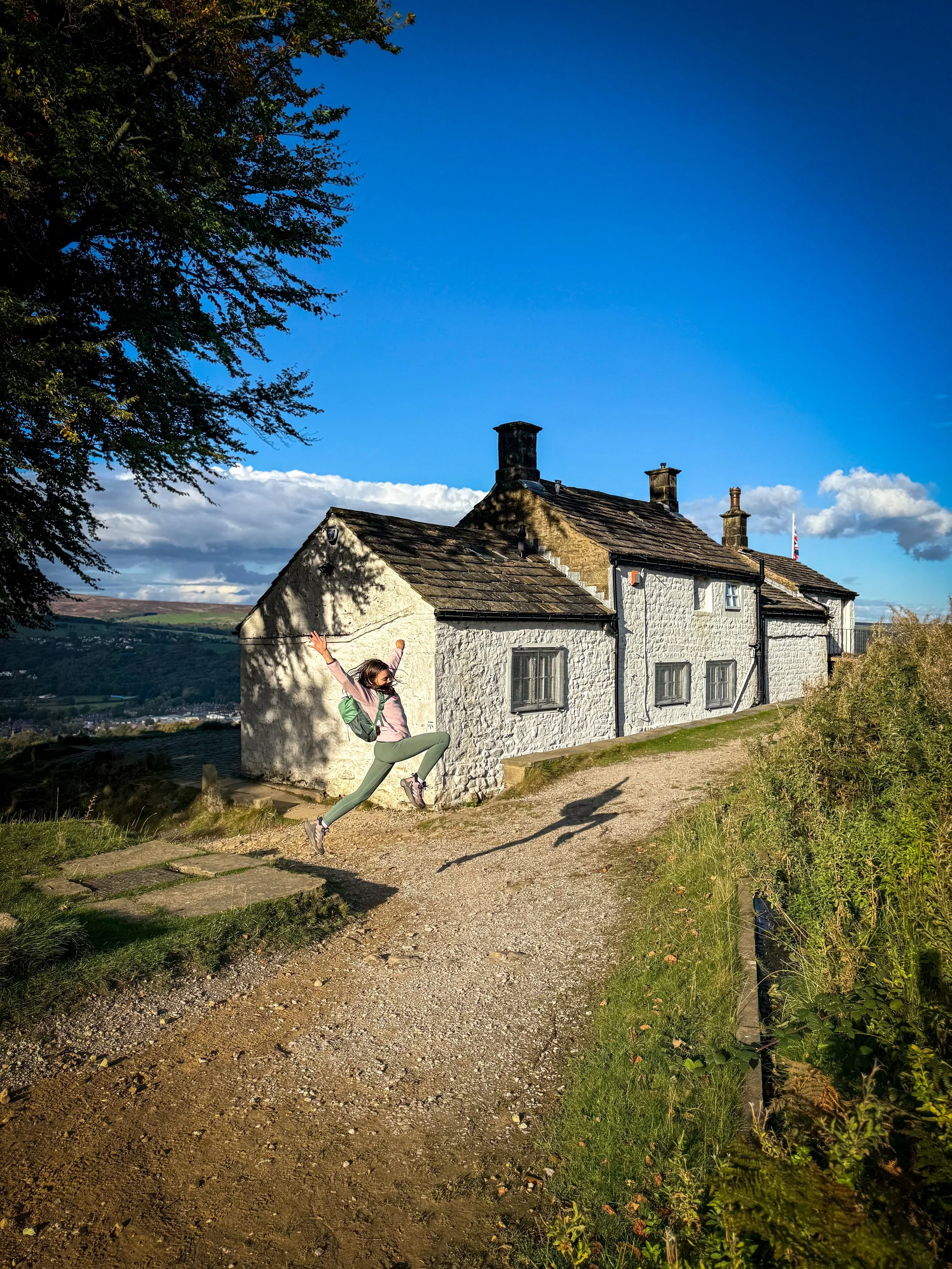
The historic spa of White Wells on Ilkley Moor, famous for more reasons than you’d expect!
The Fairy Folk of White Wells: Ilkley, Wharfedale
Ilkley Moor AGAIN? I hear you cry!
Oh Ilkley Moor has many tales to tell and they aren’t just about its famous giant! This tale takes us back to 1800’s and the Folklore Record of 1878, by John Dobson.
If you have absolutely no idea about what White Wells is, I’ll fill you in. Back in 1699, a building was erected by the then landowner, William Middleton to house the waters of the spring on Ilkley Moor. It was thought that they had healing properties and it became particularly fashionable to come and take them at the spa. It gained popularity throughout the 18th century, leading to the town’s boom in the 19th century, thanks to the multiple hydropathic establishments that popped up throughout the area. Ilkley became well known for its restorative waters and people flocked there to partake, including Charles Darwin himself.
Bottom line, White Wells is the OG Spa in Ilkley and it still operates as a bath house to this day, whereas the fancy hydros have either been demolished or turned into apartments.
Now, you can enter the spa for the price of a cup of tea in the cafe, to take a dip. What you’ll find is a deep pool, filled with crystal clear water fed directly from the spring on the moor.
But what William Butterfield saw when he tried to unlock the door of the baths to open them up for the day back in the 1800’s, was quite different. The story tells us that upon putting his key in the lock of the spa, he found that it simply turned round and around, not catching the latch to open it. He checked it was in fact the correct key (which of course it was), and tried again to no avail. Assuming the lock was broken, he attempted to force the door open and succeeded to push it open a crack, before it was immediately pushed back from the other side.
Perplexed, William shoved the door again, this time bursting fully into the bathhouse where he was met with QUITE the scene. He describes hearing a ‘whir, whir, whir’ and chattering as several small green creatures bathed in the waters of the spa. When he began to speak to them, they were startled and flew away, disappearing out onto the moor.
Now… cast your mind forwards to a gloomy December day in 1987. Retired police officer Philip Spencer was up on the moor on the morning of the 1st of December on the hill that sits right above the spring of White Wells. It was here that he claims to have seen a little green man, an alien, one that he managed to photograph before he ran away to his ‘spaceship’.
An alien? Or maybe, just maybe… it was one of those fairies…
Walk our White Wells walk to see if you can spot the Ilkley Moor fairies!
The Kilnsey Fairies: Kilnsey, Upper Wharfedale
These guys stepped straight out of an Enid Blyton novel and showed themselves to a traveller passing by in Kilnsey, they were dancing in a field under the famous climbers’ paradise, Kilnsey Crag, and left a fairy circle of toadstools behind… CLASSIC fairy story right there!
Want to head to Kilnsey? It’s like the hub of Dales outdoor adventures! Why not head to Kilnsey Park or take a pony trek with Kilnsey Pony Trekking Centre?
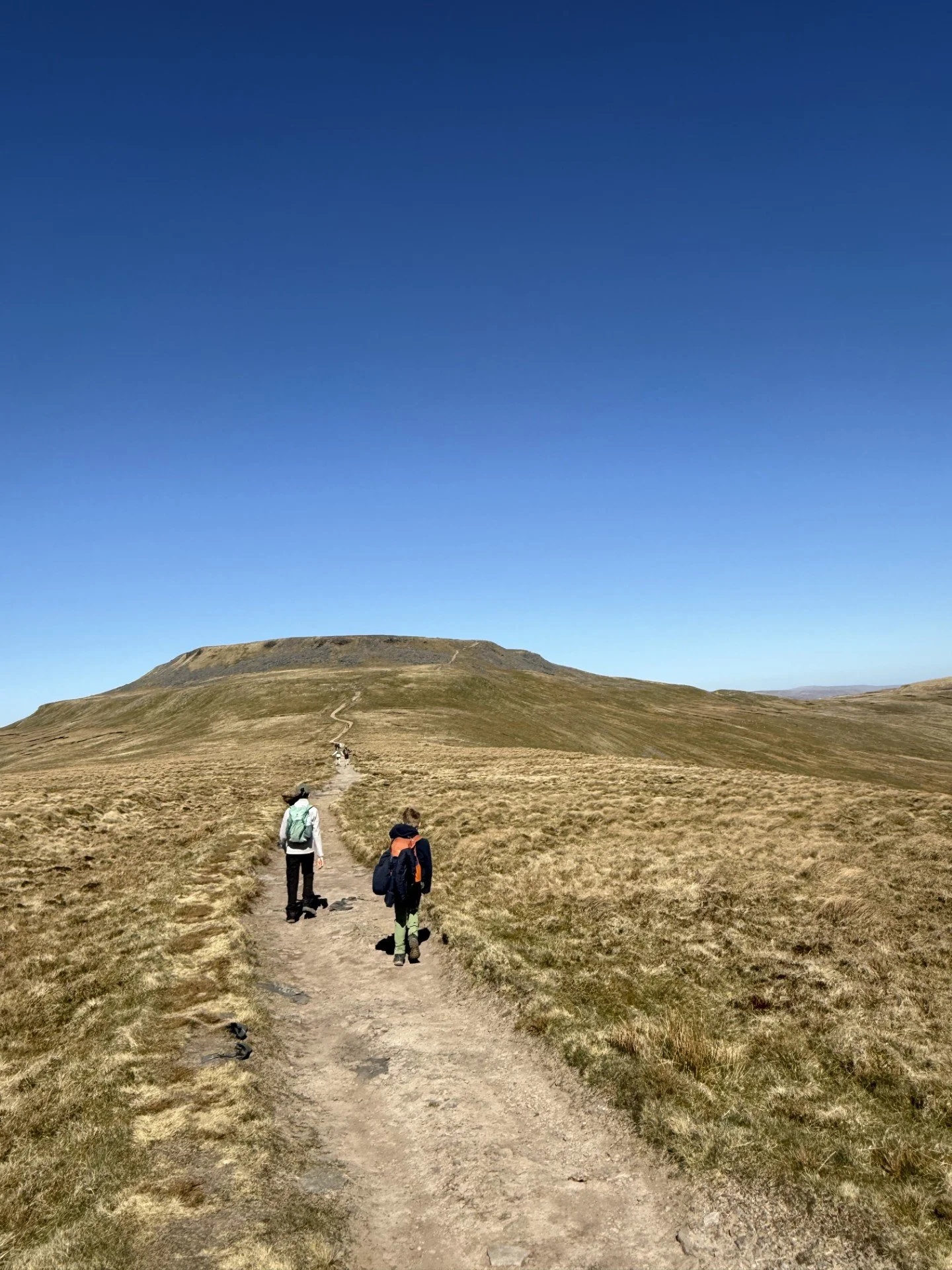
The top of Ingleborough
The Ingleborough Fairies
Ingleborough is such an iconic mountain, it’s not a surprise that it has such a legendary reputation!
If you’ve never paid the second highest mountain in the Yorkshire Dales a visit yourself, you might be forgiven for not really understanding its true glory. Because this flat topped beast has seen some pretty epic things throughout history. The entire top of the mountain (which is so flat, it almost resembles a very rocky cricket pitch) is the site of an ancient hill fort, which was filled with seasonal settlements. Fast forward to 1830 and the summit was the home of a hunting tower, built by the landowner to shelter hunting parties on the mountain. At it’s celebratory opening party, a horse race was held on the top of Ingleborough and during the course of the day, a group of irritated locals succumbed to drink and tore the whole thing down! It was never replaced, which feels like a lot of wasted effort to me!
If you walk up to the summit from Clapham, you will pass Ingleborough Cave and Gaping Gill, two of the many caves found on the side of the mountain. It is these caves which got the locals imaginations whirring, as they were widely recognised as being portals to the magical underworld and to the land of the dead.
It’s not a big leap therefore to see why the Ingleborough caves were rumoured to be the home of fairy folk, complete with eerie lights and sounds, particularly at night. Just like the Elbolton fairies, these magical lights were designed to lure weary travellers off their path and to certain doom.
Who even knew that fairies were actually pretty mean?!
If you want to check out the fairies of Ingleborough, try our family friendly walk!

The Buttertubs in Swaledale (don’t worry, these are the shallow end!)
The Hobgoblins, Boggles and Boggarts
Buttertubs: Swaledale
The Hobgoblins of the Yorkshire Dales remind me of Dobby the House Elf from Harry Potter. They were helpful around the house if you treated them well, but they were NOT happy if you didn’t and would cause mischief aplenty.
And in a departure from the JK Rowling version, Hobgoblins who were SUPER cross turned into Boggarts (picture if you will…. tiny hobgoblin versions of the incredible Hulk..) and they would hide in the dark places; the water carved gorges, the caves and the potholes being all smouldering and angry and stuff… Places like The Buttertubs in Swaledale or the mines of Buckden… places that sound like they’ve come straight out of Lord of the Rings!
The Buttertubs are an awesome phenomena which appear on the side of Buttertubs Pass, crossing between Wensleydale and Swaledale. They are a series of limestone potholes that reach about 25 metres below the surface at their deepest point (rest assured the above picture was taken at the shallow end of the Buttertubs pool!)
They are apparently called the Buttertubs because they used to be used as a ‘fridge’ for butter back in the day when the farmers were carrying their produce across to the market. The deep holes provided a cool spot for the butter to sit whilst the producers took a well earned break. If you’ve been over Buttertubs in the car, you’ll know exactly how strenuous that journey must have been!
Wonder if those hobgoblins had butterfingers…
You can park up and see the Buttertubs on Buttertubs pass, what 3 words handrail.deflation.bolts.
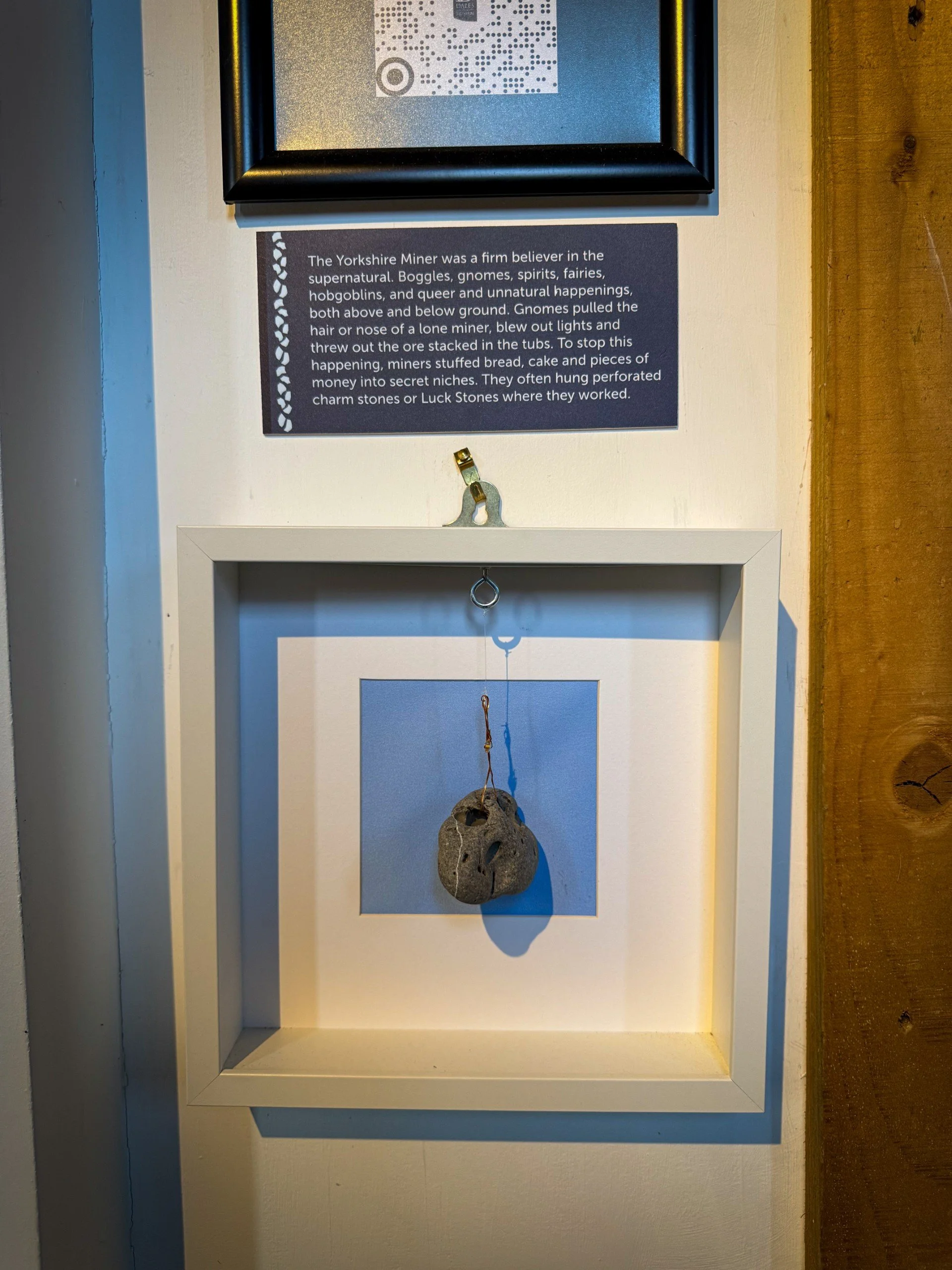
A boggle stone, or luck stone to ward off evil spirits
The Boggles and the Lead Mines
It doesn’t take a long trip into the Dales, before you see clear signs of its industrial past. Scheduled monuments such as Gunnerside Gill and The Old Gang Smelt Mill show that the rugged moorland and hillsides were in fact once a hub of activity, filled with the sounds of the lead miners.
Days spent underground in the levels of the mines would have been long, arduous and blummin’ hard work. Throw in the fact that they were pretty dangerous and you won’t be surprised that the mining community were quite a superstitious bunch who firmly believed in the beasties that lived under the surface, fairies, gnomes and boggles. The creatures who lurk in the dark places of the earth.
In order to ward off these evil spirits they left tributes to them, like bits of food or money squirrelled away in the mining tunnels. Or they hung ‘luck stones’ or boggle stones (as in the picture above).
If you fancy walking where the boggles live, then head to one of our ruins walks! Grassington has a whole lead mining trail above the market town, our walk from Hebden takes you right to the trail!
The Hurtle Pot Boggart
If you’ve heard of the Yorkshire Three Peaks, then you’ll probably have heard of Chapel le Dale. This tiny little hamlet is found on the valley floor between Ingleborough and Whernside and is where you’ll find the Wethercote Cave system. This ex Victorian show cave is on private land and is no longer open to visitors due to it being unsafe and unstable. Only cavers granted rare special permission from the land owners can access the stunning cave, which is in fact home to a top waterfall, but also to collapsing walls. So definitely one to give a miss to any of us lay-folk.
Along from Wethercote cave is Hurtle Pot. The two are connected, something that was established back in the Victorian times when a lady who was visiting lost her glove into the water of Wethercote. It later turned up downstream at Hurtle Pot.
Fun times huh? But WHY oh WHY is there a Boggart in Hurtle Pot? Well. It is flooded, only accessible to that special type of human, the cave diver. I like caves, but being totally reliant on equipment to not… well to put it bluntly, die, well - it might be a step too far for me!
Anyway, the system around Hurtle Pot is totally flooded. After heavy rain, it makes a very odd gurgling sound, which echoes out from the pot. It’s this sound which gave rise to the rumour that in fact there was a boggart in the hole.
Seems fair.
The Boggarts’ Roaring Holes: Ingleborough
These might be some of the only boggarts named on an actual Ordnance Survey Map (a bit like how the Crier at Claife in the Lake District is the only named ghost on a map).
These potholes are found on the side of Ingleborough (I KNOW! It’s literally the only mountain that’s featured in almost all of the spooky tales blogs!) and were so called after they were named by the Balderstons in the 1800’s. The Balderstons were local historians and cave explorers who were responsible for exploring a lot of the cave networks in the area. The boggarts that dwell inside these pots are flesh eating and pretty angry.
You can hear their growls from above the surface…
OR. It’s just the water coursing through the underground cave system! You can walk ALMOST right past them if you take our Ingleborough from Ingleton route!

Grimwith Reservoir, just above Dibbles Bridge (Or Devil’s Bridge)
The Devil Bridges
Dibbles Bridge: under Grimwith Reservoir, Wharfedale
Not far from Elbolton Hill and Trollers Gill lies Dibbles Bridge, the bridge that crosses the River Dibb near Grassington (also one of the shortest rivers in the UK)
And did you know that Dibbles Bridge was built by the Devil?
Known locally as Devil’s Bridge, this bridge was allegedly built by Satan himself as a favour for a local shoemaker, who had had a drink with him.
I mean… given the Devil’s reputation, it seems he was feeling in a pretty generous mood on this day!
Sadly, Devil’s Bridge has a pretty dismal reputation as being the site of the UK’s worst traffic accident, when the brakes failed on a coach killing 32 people who were paying a visit to the Dales back in 1975. And some 50 years earlier in 1925, the same thing happened, as the brakes failed on another coach, killing 7 people.
Super sad stories indeed.
Want to walk it? Why not head to Grimwith Reservoir, just above Dibbles Bridge

Devil's Bridge crossing the River Lune at Kirkby Lonsdale
The Devil and Kirkby Lonsdale
In a legendary sense, to say that the Devil was pretty fond of Kirkby Lonsdale is rather an understatement. He has not one, but THREE connections to the beautiful market town and its surrounding areas.
The Devil’s Punchbowl nearby was created by him chucking a rock at a church. The direct hit buried the church underground and left a large depression in the earth. The stone circle at nearby Casterton was created by him just dropping some rocks when his apron strings broke (I mean the devil wearing an apron. I always imagine a frilly one…) and probably his most famous input to the area, Devil’s Bridge.
Devil’s Bridge in Kirkby Lonsdale was another demon designed structure. The story behind this bridge begins with a lady losing her cow to the other side of the river. (I ask HOW did the cow get across the river when the woman couldn’t?! Well I guess actual logic, reason or sensibility never really plays a part in these here legends eh?!)
Anyway. In total dismay, the woman called upon the help of the Devil to help her get her cow back and he, in return built her a bridge. The price of such dastardly dealings? The Devil would claim the soul of the first living creature to cross the bridge. Check out the Devil, being all devil-like and all.
Turned out that the Devil had underestimated the woman, who despite not being able to fathom out how to get her cow back, COULD come up with a plan to outsmart the Devil. Rather than cross the bridge first herself, she sent her dog (poor dog).
The Devil was pretty annoyed about that actually.
The End.
Why not try out our Devil’s Bridge walk in Kirkby Lonsdale.
Hell Gill Bridge, Mallerstang
Ready for some more Devil Construction sites?
Enter, Hell Gill Bridge in Mallerstang. This utter beaut of a location boasts its very own Devil built bridge. This time spanning the incredibly beautiful Hell Gill.
Hell Gill by name, Hell Gill by nature. After heavy rain, the beck absolutely RAGES through this narrow rocky chasm. In drier times, it is the place of dreams for adventurous souls, who scramble their way down the rocky ravine, negotiating its plunge pools, and traversing it’s rocky edges that are hung with draping greenery, sheltered by towering trees high up above.
Hell Gill…. oooooh I LOVE this place. It’s like something out of an Indiana Jones movie.
Anyway, less about the drama below, more about the drama above! Yes, Hell Gill bridge was of course built by the Devil, who was having a RIGHT mare crossing the aptly named Hell Gill. He built the original bridge using stones he collected from the top of the mountains above. There is a pile of rocks nearby attributed to the Devil’s construction. Apparently he didn’t need those ones…
The Devil’s Grinding Mill or Mustard Pot in Kirkby Stephen
The Devil Loves Mustard (pass it on): Kirkby Stephen
Who knew eh?
The Devil’s Mustard Mill/ Mustard Pot/ Grinding Mill (it goes by many names) in Kirkby Stephen is when the Devil took a brief step away from all that bridge building and decided to make himself a ham and mustard sarnie. What? Everybody deserves a break sometimes right?
But WHERE OH WHERE WILL THE DEVIL GRIND HIS MUSTARD?
Here, in this curious geological phenomenon in Stenkrith Park. I mean look at it, it SCREAMS mustard grinding to me doesn’t it to you?
Otherwise known as Coopkarnel hole (or Coop Kernan Hole… it has SO MANY NAMES!!) what you’re actually seeing is part of a collapsed cave system known as the Angel’s drainpipe. If you head down from the viewing bridge to the path below, you will see the towering sides of the gorge through which the River Eden flows. The water cascades and swirls around circular holes in the rock, created by churning pebbles, which have worn away at the surface.
It’s in these holes that legend tells us, the Devil grinds his mustard seeds, thereby satisfying his desire for a bit of heat on his ham!
And if a mustard mill isn’t enough legend for you, then check out what could well be our most legendary family friendly walk that begins in Kirkby Stephen. It heads past the ancient Loki stone (which depicts the Norse God Loki) and then past a haunted bridge before heading onto the grinding mill! Tap the link to head to our Stenkrith Park walk.

The Vampire Stone set at the doorway of St Andrew’s Church in Dent
Vampires
The Dent Vampire: George Hodgson
Do you see the picture Above?
That is the headstone of George Hodgson, the Dent vampire and what a story he has!
Old George died at the ripe old age of 94 back in 1715. A pretty decent lifespan for the 18th Century! OBVIOUSLY nobody could do anything out of the ordinary (like achieve any kind of longevity) without some superstition being flung their way, so his long life was put down to a diet of sheep’s blood and therefore…… ultimate conclusions… he was a vampire (obvs!)
(I mean what even IS a legend if we don’t make some GIGANTIC leaps to conclusions eh?)
Old George passed away, was mourned and buried in the usual fashion in the churchyard of St Andrew’s in Dent…. UNTIL….
There was a series of mysterious deaths in the area, long after poor old George’s death. Thereafter followed a few claims that some of the village folk had seen George floating around at night, even after his demise. (Definite vampiric behaviour if you ask me!)
So wham bam and before you could even say Interview with a Vampire, George was exhumed from his grave at the edge of the graveyard in St Andrew’s churchyard to be examined posthumously.
His exhumed state was something of a surprise to those who examined him, as he was found to be pink and healthy, with his hair and nails having grown despite being loooooong gone.
So, not satisfied that he was dead enough…. he was buried again, this time next to the church door with a brass stake through his heart.
The stone can still be seen today outside the church in Dent, but what about George?…
You can pop to see the vampire stone as part of our Flintergill walk.

The ruins of Pendragon Caslte in Mallerstang
King Arthur (and all that…)
Pendragon Castle
Tucked away in one of the most remote parts of the Yorkshire Dales, you’ll find the ruins of Pendragon Castle.
Yes, THE Pendragon Castle.
Legend has it that this castle was built by Uther Pendragon back in the 5th Century, who was the father of King Arthur. Him and 100 of his men were allegedly poisoned here, after the Saxon invaders contaminated the water supply (although this could well….. get it? ‘well’…. not be true. Ahem. Sorry about that).
One of my favourite legends of this place is that there is rumoured to be treasure buried beneath the ground of Pendragon Castle, which is protected by a phantom black hen, who replaces any soil disturbed in any attempt to recover the treasure.
That, as well as the rumour that the ruins are of COURSE haunted by Uther and later resident Hugh de Morville, who was one of the knights that murdered Thomas Beckett in 1170. The castle was later owned and restored by Lady Ann Clifford (of Skipton Castle and Bolton Abbey fame) before falling into ruin.
The ruins are located on private land, but are open to visitors free of charge. There is a handy little parking area directly opposite. Well worth a stop on a wild journey through Mallerstang!
Lammerside Castle, just down the road from Pendragon
Can’t mention Pendragon and not mention it’s neighboring castle, Lammerside, that you will find just a stone’s throw away!
Lammerside Castle has one foot in the Giant category and one foot in King Arthur’s Category! So here it is.
Lammerside is a 12th Century castle, the ruins of which you will find on the side of the Pennine Journey footpath in Mallerstang near the River Eden. This castle was the home of the giant, Sir Tarquin and Lammerside was reportedly his mythical castle of Dolorous, his home.
Apparently he ate children.
Well I guess he was a giant. Seems like a pretty standard giant diet to me.
And finally, a phantom chicken.
Guarding treasure in Reeth, Swaledale at Maiden Castle.
And on that note….
Hope you enjoyed! You can follow us over on Facebook or Instagram to see more of our Yorkshire Dales adventures.

Yorkshire Dales Ghosts Fan?
Or maybe you prefer a bit of Witch based history….. We’ve got you covered with our special Halloween Yorkshire Dales blogs!
Sources:
Haunted Yorkshire Dales: Summer Strevens
Haunted Yorkshire: Nick Tyler
The Dent Heritage Centre
Ilkley The History of a Wharfedale Town: Rhona Finlayson
Caught by the River: Ian Humberstone
Stephen Oldfield Weathercote Cave: a window into the underworld – Dales Rocks